Volume-guided diffusion
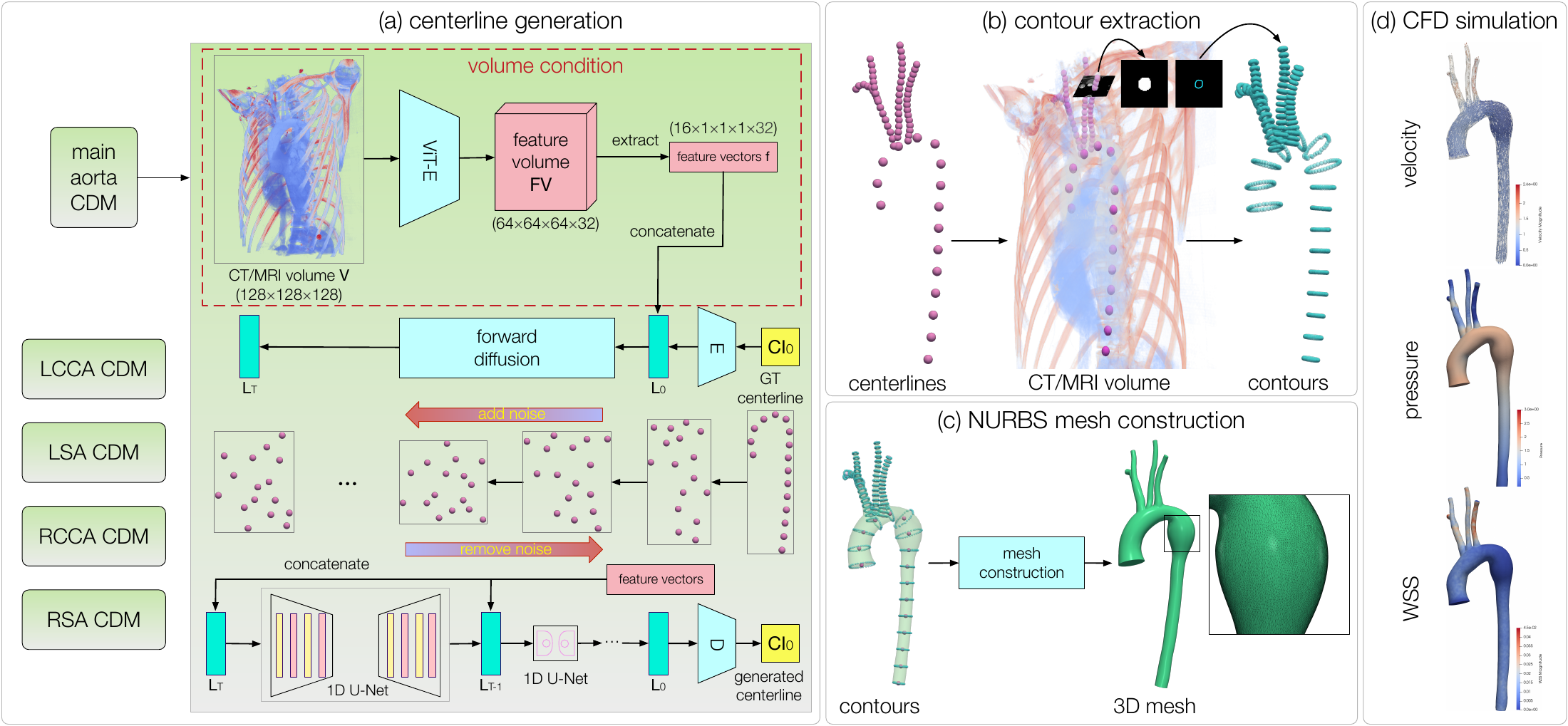
A conditional diffusion formulation uses volumetric context to generate the complete aortic centerline tree.
IEEE VIS 2025
An end-to-end path from volumetric medical images to analysis-ready, multi-branch aortic surface geometry.
Illustrative transition · stylized volume, subject005 V2 surface mesh
01 · What’s next
AortaDiff+ is under active development.
02 · Overview
AortaDiff conditions a diffusion model on CT or MRI volume information to generate multi-branch aortic centerlines. The resulting contours are reconstructed as a smooth surface suitable for downstream analysis.
High-quality vascular geometry is a prerequisite for computational fluid dynamics, yet manual and semi-automatic mesh preparation can be time-consuming and sensitive to image quality.
All subject cases and interactive meshes displayed on this homepage are derived from the AortaSeg24 dataset: Multi-Class Segmentation of Aortic Branches and Zones in CTA.
03 · Contributions
A conditional diffusion formulation uses volumetric context to generate the complete aortic centerline tree.
Generated centerlines guide contour extraction before a smooth NURBS surface is reconstructed across the aorta and its branches.
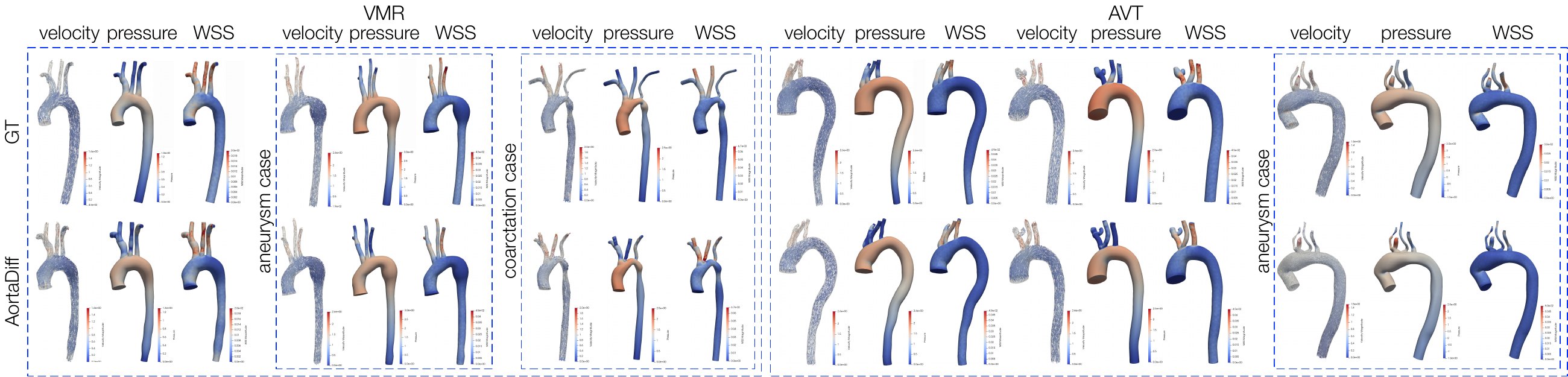
Surface quality and OpenFOAM simulations are compared with reference geometry using velocity, pressure, and wall shear stress.
04 · Interactive comparison
Subject005 exposes a V1 failure case near the junction of the right subclavian artery (RSA) and right common carotid artery (RCCA). V2 (AortaDiff+) no longer shows this unintended merge in this case.
The warm red vessels and ROI marker call attention to the unintended V1 connection.
The corrected region is highlighted in teal. Camera movement and zoom are synchronized across both viewers.
Drag to rotate · Scroll to zoom · Press R to reset
05 · AortaDiff+
Explore V2 (AortaDiff+) meshes directly in the browser. Subjects are identified only by anonymized IDs; no clinical category is inferred here. Data source: AortaSeg24.
06 · Method
07 · Results & CFD
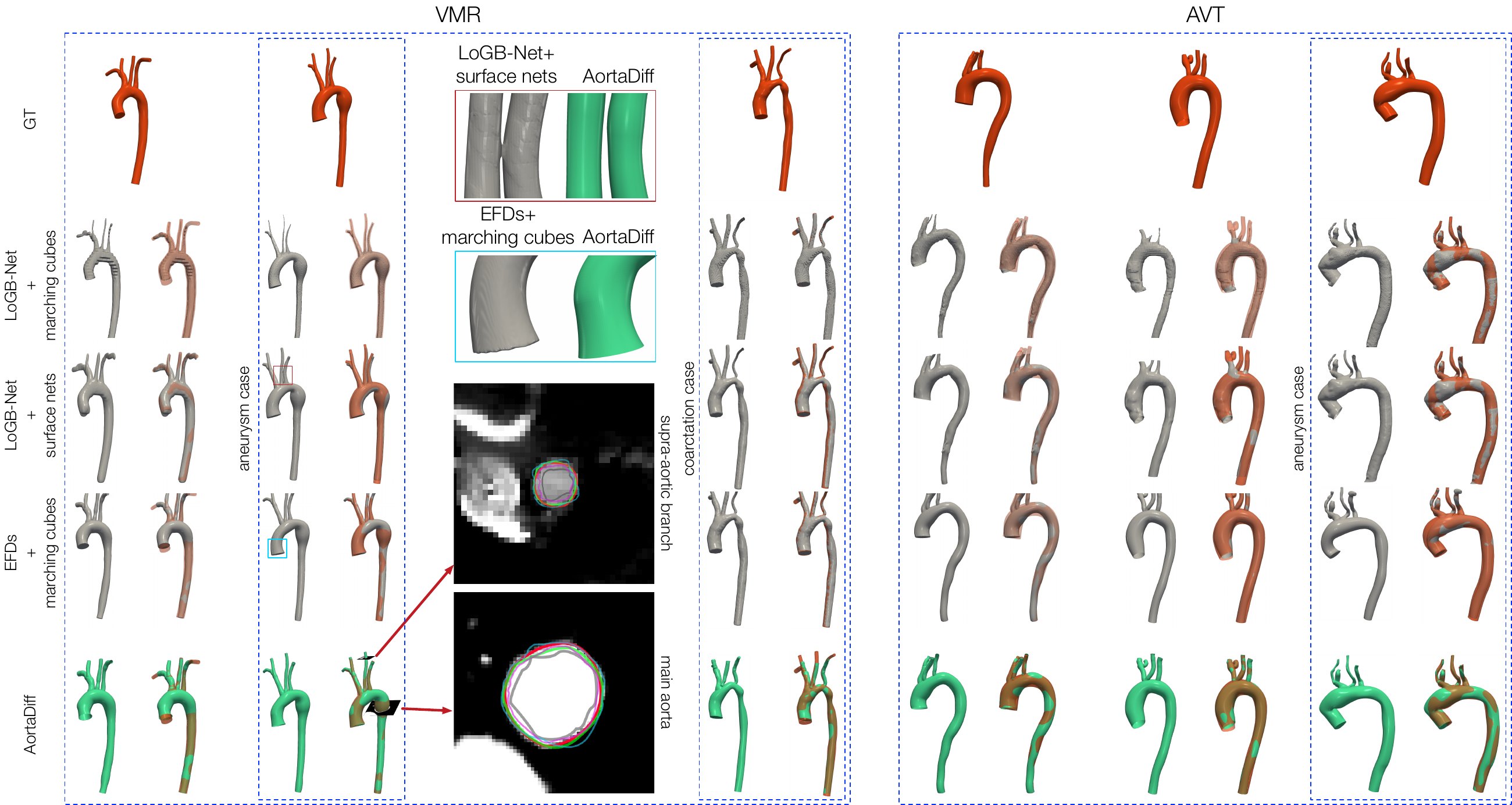
The paper evaluates generated meshes against reference surfaces and carries them into OpenFOAM simulations, comparing velocity, pressure, and wall shear stress.
08 · Video
A paper presentation covering the problem, the volume-guided diffusion pipeline, mesh evaluation, and downstream CFD analysis.
04:57 · presentation video09 · Open collaboration
We plan to generate and evaluate 1,000+ aortic meshes and welcome collaborations with vascular imaging, cardiovascular mechanics, CFD, and clinical research teams.
da568@cornell.edu10 · Citation
@article{an2026aortadiff,
  title   = {AortaDiff: Volume-Guided Conditional Diffusion Models for Multi-Branch Aortic Surface Generation},
  author  = {An, Delin and Du, Pan and Wang, Jian-Xun and Wang, Chaoli},
  journal = {IEEE Transactions on Visualization and Computer Graphics},
  volume  = {32},
  number  = {1},
  pages   = {922--932},
  year    = {2026},
  doi     = {10.1109/TVCG.2025.3634652}
}